
Trauma Healing
Pillars of Trauma Healing Work
The Window of Tolerance
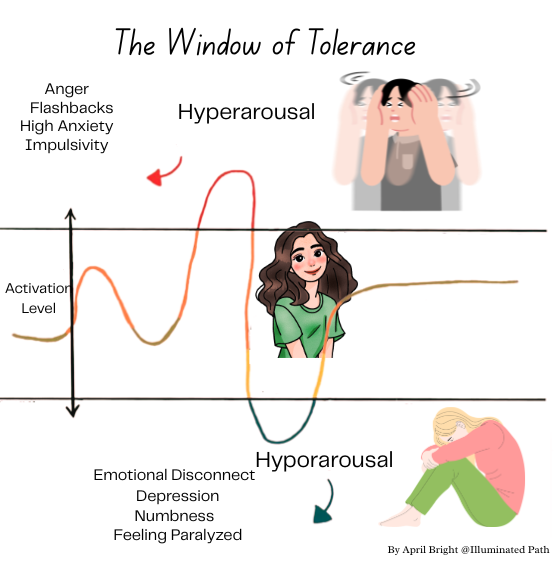
Developed by Dr. Dan Siegel, the Window of Tolerance describes the zone in which we are able to function most effectively — where we can feel our feelings without being overwhelmed by them, think clearly, stay present, and engage with life and with others. Trauma narrows this window. When we are pushed outside it, we go one of two directions:
Hyperarousal — the activation state: anxiety, panic, hypervigilance, rage, feeling flooded or out of control. The nervous system reads threat and mobilizes — heart racing, thoughts spinning, body on high alert.
Hypoarousal — the shutdown state: numbness, dissociation, flatness, exhaustion, feeling frozen or disconnected. The nervous system, overwhelmed beyond its capacity, collapses inward as a last form of self-protection.
Both states make complete sense as survival responses. Neither is a character flaw. And one of the primary goals of trauma healing is gently, consistently widening that window — so that more of life becomes tolerable, and eventually, livable.
The Hand Model of the Brain
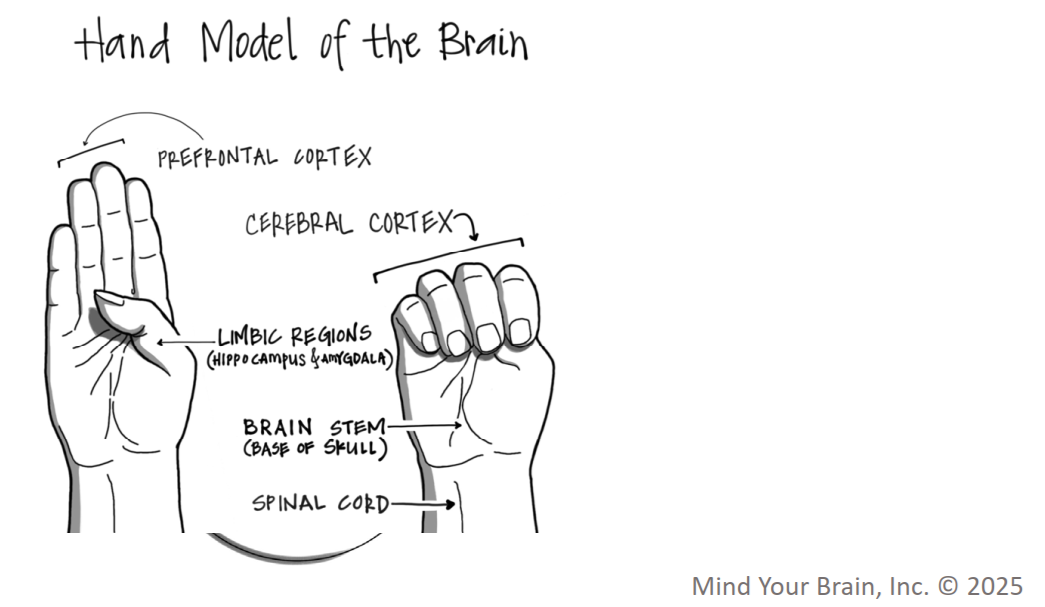
Dr. Dan Siegel's Hand Model is one of the most elegant and accessible ways to understand what happens in the brain during trauma and overwhelm.
Picture your hand as the brain. Your wrist is the brainstem — the most ancient part, governing survival. Your thumb folded into your palm represents the limbic system — the emotional brain, the seat of memory and threat response. Your fingers folded over your thumb are the prefrontal cortex — the thinking, reasoning, compassionate part of the brain that helps us make sense of our experience.
When we feel safe, all of this works together. But when the nervous system detects threat — when we are triggered — the fingers fly up. The prefrontal cortex goes offline. We flip our lid. In that state, we cannot think clearly, access empathy, or make careful decisions. We are operating from the survival brain alone.
This is not weakness. This is biology. And knowing it changes everything — because instead of judging ourselves for our reactions, we can begin to understand them, and learn how to bring the lid back down.
Developed by neuroscientist Dr. Stephen Porges, Polyvagal Theory gives us a map of the nervous system that transforms how we understand our own responses.
At its heart, it describes three states the nervous system moves through:
The ventral vagal state — safety and connection: This is where we are when we feel genuinely safe. ldest part of the nervous system pulls us into collapse. Numbness. Disconnection. The going-through-the-motions feeling that so many trauma survivors describe.
Understanding which state you are in — and having tools to gently move toward safety — is one We can connect with others, think flexibly, feel warmth, be present. This is the state healing happens in.
The sympathetic state — fight or flight: When the nervous system detects threat, it mobilizes. We become activated — ready to fight or run. In trauma survivors, this state can be triggered by things that feel ordinary to others but carry the echoes of past danger.
The dorsal vagal state — shutdown and freeze: When threat feels inescapable or overwhelming, the oof the most empowering things trauma healing can offer.
The Polyvagal Framework
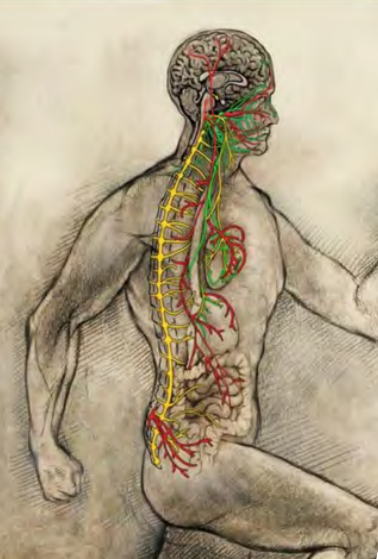
The Vagus Nerve - 10th Cranial Nerve, that travels throughout the body Image by Gabriel Kram
Nervous System Regulation Tools
Healing trauma is not primarily about revisiting the story — it is about teaching the nervous system that it is safe now. That it can rest. This happens through repetition, through relationship, and through the body itself.
Some of the tools that I teach people are:
Breathwork — extended exhales activate the parasympathetic nervous system, shifting us from activation toward calm. Something as simple as breathing out for longer than you breathe in begins to change your physiological state.
Orienting — slowly looking around the room and noticing what is present engages the social engagement system and signals to the nervous system that the current environment can be assessed as safe.
Bilateral stimulation — the Butterfly Hug — crossing your arms over your chest and alternately tapping your shoulders activates both sides of the brain in a gentle, rhythmic way that supports nervous system regulation and is used widely in trauma-informed practice.
EFT Tapping — a gentle, evidence-informed practice that involves tapping on specific acupressure points on the face and body while focusing on a distressing thought, feeling, or memory. Tapping sends a calming signal directly to the amygdala — the brain's alarm system — helping to reduce the emotional charge around difficult experiences. It can be used in the moment for anxiety or overwhelm, and over time as a tool for processing stored stress and trauma responses.
Grounding — making contact with the present moment through the senses — feeling your feet on the floor, the texture of what you are touching, the temperature of the air — helps anchor you in the now when the nervous system is pulling you into the past.
Movement — the stress response is designed to be discharged through the body. Walking, shaking, gentle stretching — these are not small things. They help complete what the nervous system started.
Mindfulness - as a regulation tool. Click here to learn about the extraordinary benefits of mindfulness meditation.
Co-regulation — the healing power of safe connection. One of the most powerful regulation tools is not something you do alone. Co-regulation is the nervous system's capacity to find calm through the presence of another regulated nervous system. A trusted friend, a therapist, a support group, a partner who can stay grounded when you cannot — these are not luxuries in trauma recovery, they are medicine. The same is true for pets. The steady, unconditional presence of an animal can shift your physiological state in ways that are measurable and real. We are wired from birth to regulate through relationship. Finding even one safe connection is one of the most powerful things you can do for your healing.
Self-Compassion as a Trauma Intervention
Drawing on the research of Dr. Kristin Neff, self-compassion is woven throughout trauma-informed work — because one of trauma's cruelest legacies is often the way it turns us against ourselves.
Trauma survivors frequently carry enormous shame — about what happened, about their responses, about the ways they have coped. That shame is not the truth. It is a wound layered on top of a wound.
Neff's three components — self-kindness, common humanity, and mindfulness — offer a direct antidote. Learning to meet your own suffering with the same warmth you would offer someone you love is not a soft add-on to trauma healing. For many people, it is the heart of it. You can read more about self-compassion in our blog post dedicated to Kristin Neff's work.
Processing Trauma — When the Time Is Right
Nervous system regulation tools are not the destination — they are the foundation. Learning to calm and stabilize your system is the essential first work of trauma healing, because deeper processing cannot happen from a place of overwhelm. But once enough safety has been established — once you can bring yourself back to a calmer state, once trust has been built in the therapeutic relationship — the next layer of healing becomes possible.
This work moves through three natural phases:
Stage 1 — Let It Be. Before anything can change, it must first be acknowledged. This stage is about building safety, learning to regulate your nervous system, and developing the tools that allow you to stay present with difficult experiences without being overwhelmed by them. We are not yet moving toward the wound — we are building the ground beneath your feet so that when we do, you will not fall.
Stage 2 — Let It Go. This is the processing stage — where we gently return to what happened, not to relive it, but to help the nervous system finally complete what it could not finish at the time. To integrate the fragmented pieces. To bring the wisdom and safety of the present moment into contact with the parts of you that are still living in the past. This is where old beliefs begin to loosen, where the body releases what it has been holding, and where the story of what happened stops defining who you are.
Stage 3 — Let the New In. Healing is not only the absence of symptoms — it is the presence of something new. This stage is about rebuilding. A new relationship with yourself, with others, with the future. Reclaiming the parts of you that trauma pushed underground. Discovering who you are when you are no longer organized around survival.
This work is done carefully, collaboratively, and always at a pace your nervous system can tolerate. It is never rushed. And it is where true healing — not just management of symptoms, but genuine freedom — becomes possible.